
R.B. Kitaj
R. B. Kitaj (1932-2007), born in Cleveland, Ohio, lived and worked in London and later in Los Angeles. A major figure of postwar British art, he developed a distinctive figurative style drawing on literature, history, politics and the visual culture of modern life. His paintings and prints combine fragmented imagery, bold colours and complex networks of references, often bringing together seemingly unrelated historical and cultural subjects. Kitaj’s work is characterized by its intellectual breadth and literary quality, reflecting his fascination with Jewish identity, diaspora, European history and the experience of modern life.
R.B. Kitaj Editions
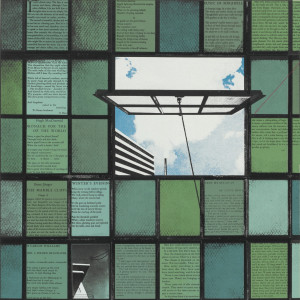
The Gay Science
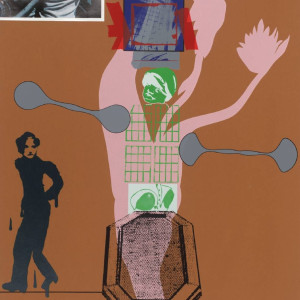
His Every Poor, Defeated, Loser’s, Hopeless Move, Loser, Buried (Ed Dorn)
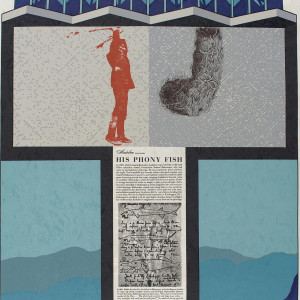
The Flood of Laymen
R.B. Kitaj
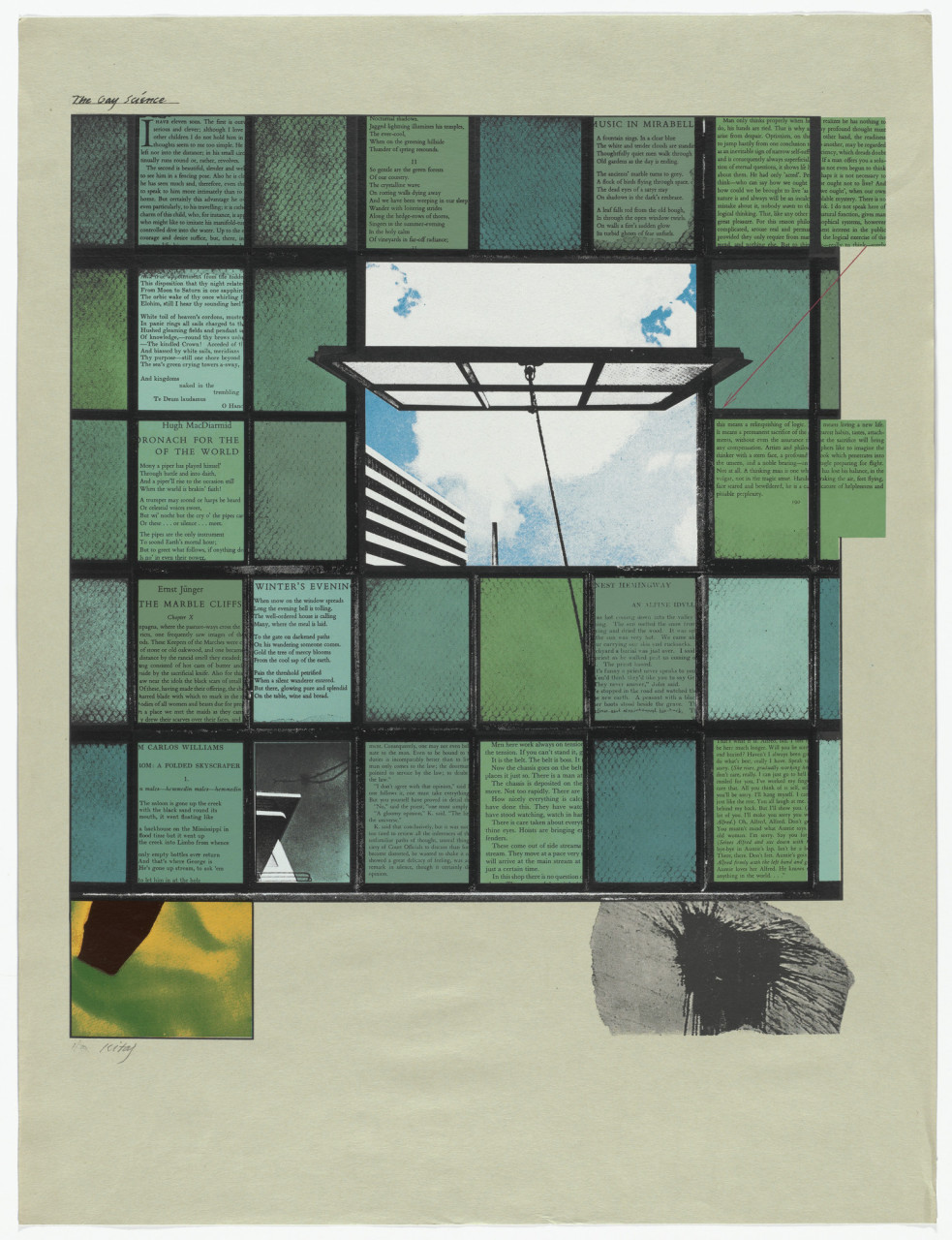
The Gay Science
1966
Screenprint on paper, 77 x 58.5 cm. Edition of 70, signed and numbered.
R. B. Kitaj’s edition The Gay Science (1965), from the portfolio Mahler Becomes Politics, Beisbol, combines photographic imagery, printed text and geometric structures in a complex, dreamlike composition. A view of blue sky and clouds appears through a grid-like architectural framework, surrounded by fragments of poetry and prose, while additional photographic and abstract elements occupy the lower part of the image. The fragmented perspective and juxtaposition of disparate materials create a sense of visual and intellectual layering characteristic of Kitaj’s work.
The portfolio was inspired by Kitaj’s friendship with the poet Jonathan Williams and Williams’s book of poems Mahler, which responded to the symphonies of Gustav Mahler. The title The Gay Science echoes Friedrich Nietzsche’s philosophical work of the same name and reflects Kitaj’s interest in bringing together literary, musical, political and cultural references. The work is in the collections of The Museum of Modern Art, New York, and Tate, London.
EUR 2,500
R.B. Kitaj
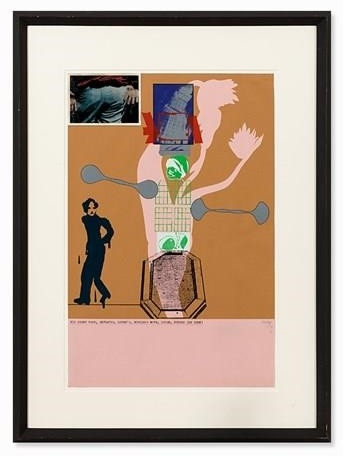
His Every Poor, Defeated, Loser’s, Hopeless Move, Loser, Buried (Ed Dorn)
1966
Screenprint with collage, 77 x 50 cm. Edition of 70, signed and numbered.
This edition by R. B. Kitaj exemplifies his characteristic collage-like approach to printmaking. A pale pink female figure with raised arms is combined with photographic fragments, geometric forms, a dark silhouette and printed text. The enigmatic title derives from a poem by the American poet Ed Dorn.
The work belongs to Mahler Becomes Politics, Beisbol, a portfolio of fifteen colour screenprints accompanied by a book of poems by Jonathan Williams, each relating to one of Gustav Mahler’s symphonies. Kitaj first became deeply interested in Mahler in 1964, and the composer’s connection to Vienna was particularly significant for him. Kitaj’s stepfather was a Jewish refugee from Vienna, and his engagement with Jewish identity and European culture became increasingly central to his work. His art often draws closely on his biography, weaving personal, literary and historical references into complex visual compositions.
The work is held, among others, in the collections of The Museum of Modern Art, New York, and Tate, London.
EUR 1,800
R.B. Kitaj
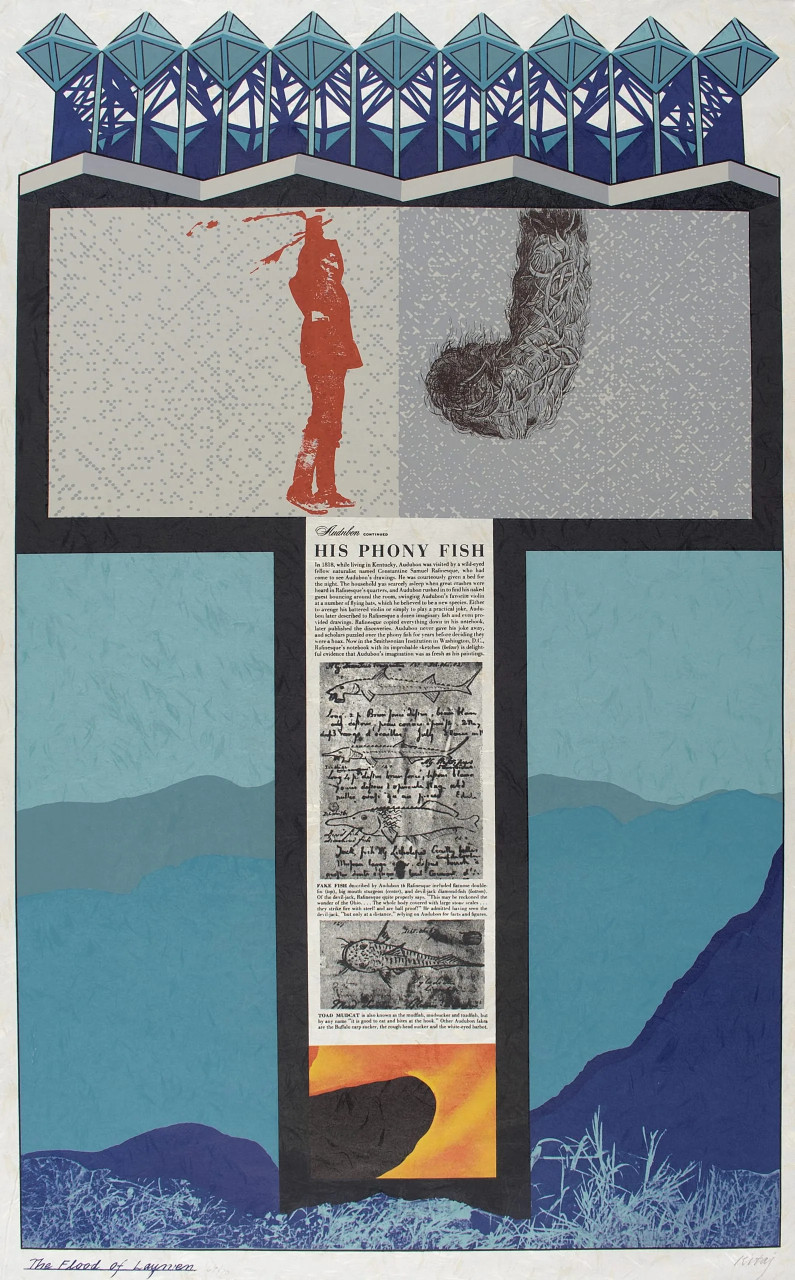
The Flood of Laymen
1964/67
Silkscreen on paper, 82.6 x 56.6 cm. Edition of 70, signed and numbered.
The The Flood of Laymen (1967) edition, from R. B. Kitaj’s portfolio Mahler Becomes Politics, Beisbol, combines photographic imagery, geometric forms and printed text in a densely layered composition. A red silhouette, architectural elements and fragments of landscape surround a central newspaper clipping, creating a striking interplay between different visual and textual elements.
The work reflects Kitaj’s interest in literary, historical and personal references, which he often interwove within a single image. Mahler Becomes Politics, Beisbol was developed between 1964 and 1967 and comprises fifteen screenprints accompanied by a book of poems by Jonathan Williams, each relating to one of Gustav Mahler’s symphonies. Kitaj’s fascination with Mahler was closely connected to his interest in Vienna and European culture, while his Jewish heritage and personal biography became increasingly important to his work. The work is held, among others, in the collections of MoMA, New York, Tate, London, and the V&A Museum, London.
EUR 2,000

