
Claes Oldenburg
Claes Oldenburg (1929-2022), born in Stockholm, Sweden, lived and worked in New York City from 1956 onward. A leading figure of American Pop Art and one of the most influential sculptors of the postwar period, he is best known for transforming familiar everyday objects into unexpected sculptures, often through radical shifts in scale, material and form. His early environments and performances, including The Street and The Store, challenged conventional ideas of sculpture, while his later soft sculptures and monumental public works turned objects such as food, household items and consumer goods into playful and often monumental forms. In collaboration with Coosje van Bruggen, he created numerous large-scale public sculptures that brought this approach into the urban landscape.
With the permission of Claes Oldenburg, we have compiled the most comprehensive survey of his editioned works to date, documented in a freely accessible digital resource on Ars Publicata.
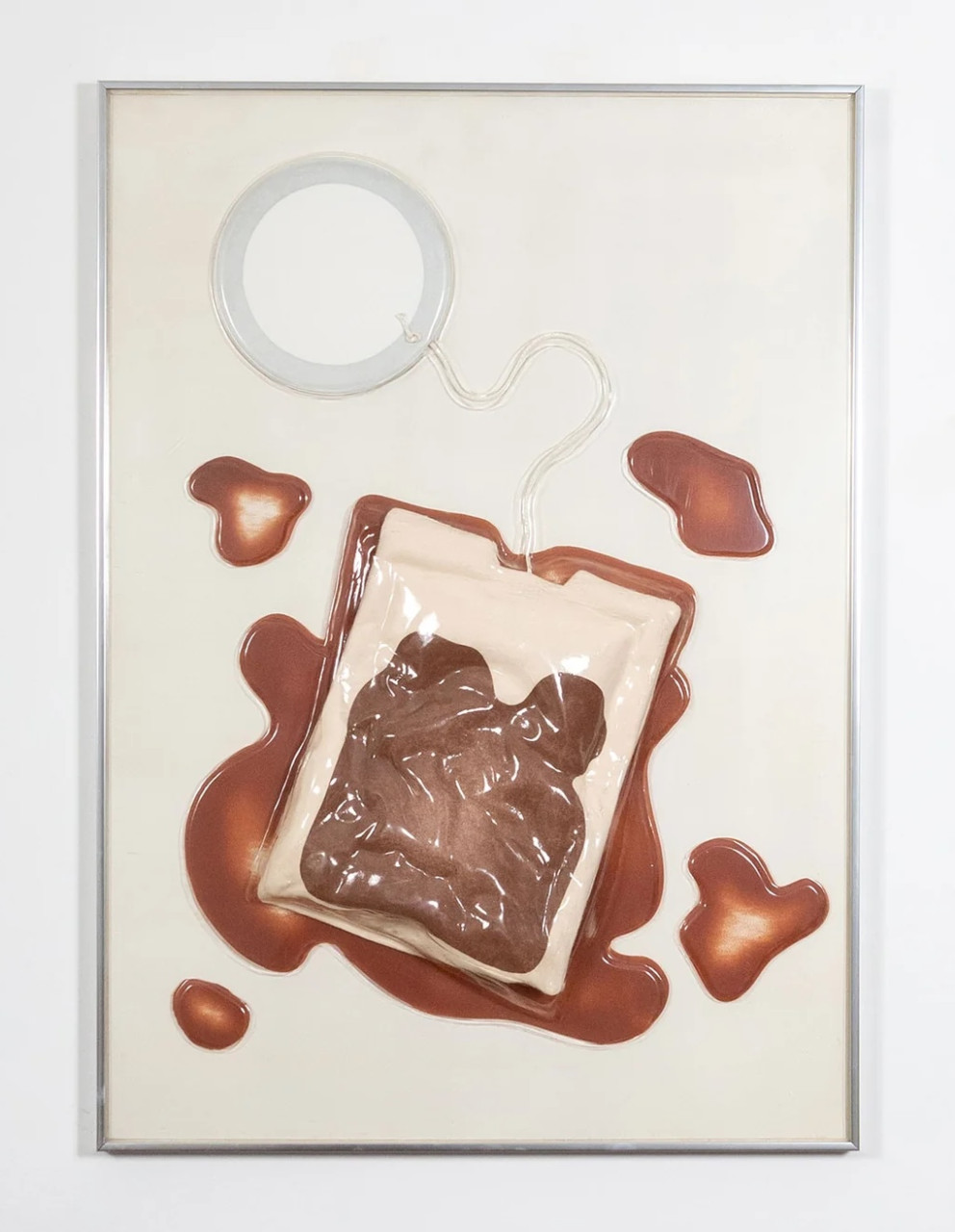
Claes Oldenburg
Tea Bag (from Four on Plexiglas)
1965
Screenprint on vacuum-formed vinyl, felt, rayon cord, and Plexiglas mounted on paperboard, 99.1 × 71.1 × 8.9 cm. Edition of 125, signed and numbered.
Oldenburg & Platzker 4
Claes Oldenburg’s multiple edition Tea Bag (1966), from the seminal portfolio Four on Plexiglas, transforms an ordinary tea bag into an oversized relief. By rendering the small, soft object in hard Plexiglas and other industrial materials, Oldenburg turns a familiar everyday item into something unexpected and slightly absurd. The stains of tea and the attached cord retain the associations of the original object while shifting it into the realm of sculpture.
Four on Plexiglas was the first portfolio published by the iconic publisher Multiples, Inc. and brought together Oldenburg with Philip Guston, Barnett Newman and Larry Rivers, each exploring the possibilities of Plexiglas as a new medium for editions. Tea Bag was particularly innovative in its use of vacuum-formed Plexiglas, which simultaneously reproduces the shape of the tea bag and the surrounding splashes of tea. The work is in the collections of The Museum of Modern Art, New York, the Smithsonian American Art Museum, Washington, D.C., and LACMA, Los Angeles.
EUR 5,000

